
Choose a question before choosing the route
A campus history walk can begin with an ordinary question: whose work made this place possible? That question is more productive than selecting the most picturesque buildings and adding stories afterward. It directs attention to labor, land, records, and the people whose lives may be less visible in familiar commemorations.
The planning exercise here describes how to build a researched walk; it is not a ready-made itinerary or a statement that any particular route is open today. Begin with a small number of proposed stops that can support the question. A short walk with clear evidence can give participants more to consider than a long route whose claims cannot be traced.
Let a documented place anchor the subject
Clemson University's history of the African American Burial Ground describes a landscape connected with enslaved people, sharecroppers, tenant farmers, domestic workers, convicted laborers, wage workers, and their families. Its account distinguishes historical periods and cites records supporting the discussion. That specificity offers a starting point for inquiry into people and institutions, rather than treating a campus landscape as an anonymous backdrop. [1]
When using such an account, retain its qualifications. A statement that people are believed to be buried at a site should not become a claim that every individual has been identified. A guide can explain what is documented and what remains under investigation. Uncertainty is part of the history being studied, not a gap that the speaker should fill with a dramatic invention.
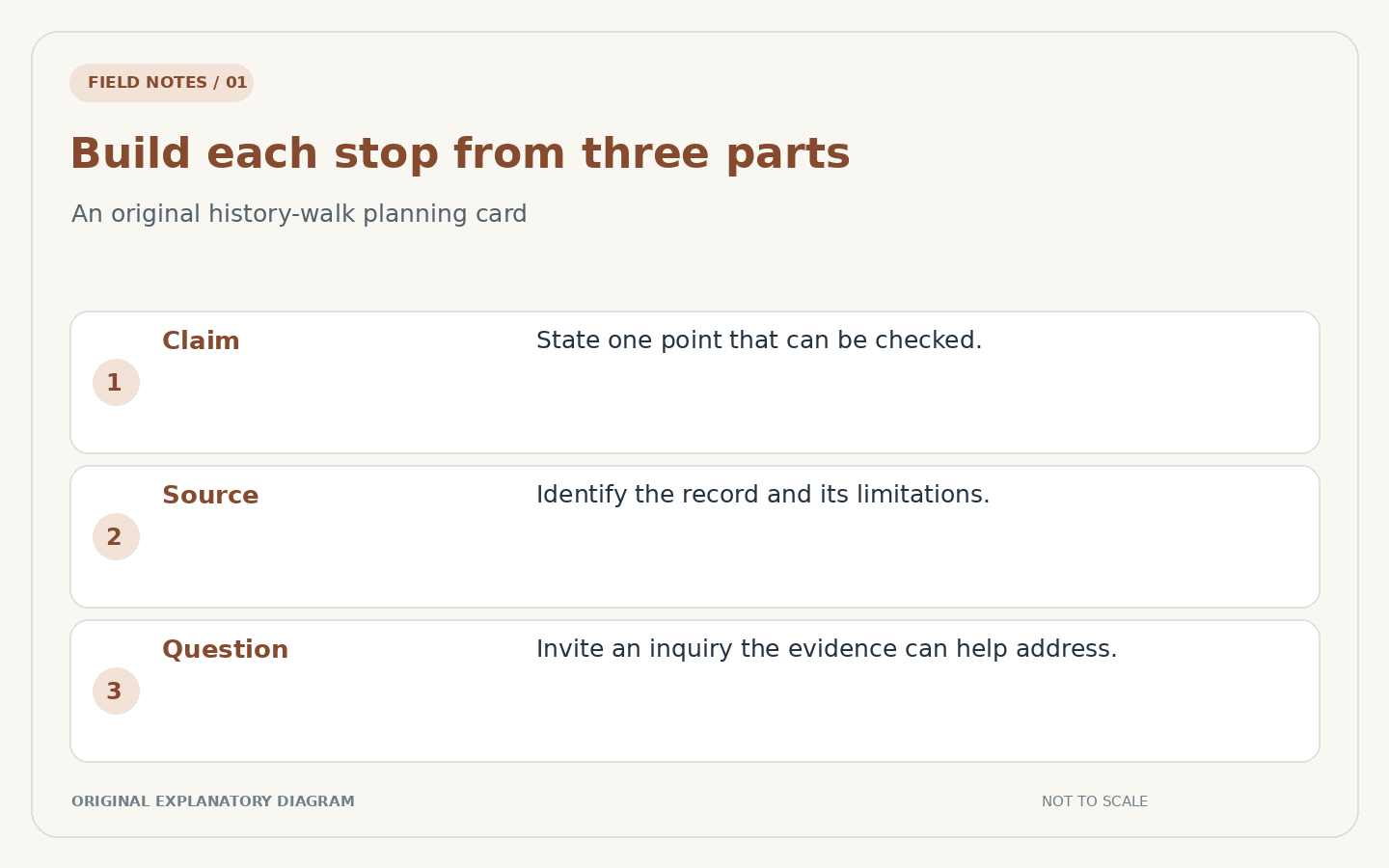
Give each stop one defensible claim
Prepare a card for each proposed stop with a claim, supporting source, and question. A claim might concern a documented use of a building, a recorded labor arrangement, or a change in how a place was commemorated. Keep it narrow enough that the source can actually support it.
Separate the location you can see from the event you are discussing. An archival record may describe work associated with an institution without locating every person's activity at the exact spot where the group stands. Say that distinction aloud. A physical setting can help visitors think about history without being presented as the precise site of every event mentioned in the narrative.
Separate observation from interpretation
The Library of Congress primary-source analysis tool organizes inquiry around observing, reflecting, questioning, and further investigation. Its prompts encourage readers to describe what a source contains before settling on an interpretation. This is a useful foundation for examining a photograph, map, contract, or commemorative inscription during a history walk. [2]
In an original exercise, show a reproduction of a fictional campus maintenance ledger. Ask participants first to identify its date, headings, and visible entries. Then ask what questions it raises about work and record keeping. Label the ledger fictional if it was created for teaching. Never let a demonstration document be mistaken for an archival discovery about the actual campus.
Prepare source copies that can be understood outdoors
A small archival image on a phone may be difficult to examine in glare or while a group is standing. Choose a readable excerpt, preserve its identifying information, and explain where it sits within the original document. If an excerpt removes surrounding context, describe the omission rather than letting the cropped image appear complete.
Provide a text transcription when useful, while marking uncertain readings and retaining the original meaning. A modernized spelling or expanded abbreviation should be identifiable as an editorial choice. The handout should help a participant return to the source later. Its purpose is to improve access to evidence, not to replace that evidence with an untraceable paraphrase.
Make room for names and for missing names
A record may name an employer, administrator, or landowner while omitting the people who performed the work. Explain that imbalance without inventing personal details to compensate for it. The absence of a name in one document is not proof that a person had no identity, family, skill, or agency.
Where a documented name is available, check its spelling, date, and context before using it. Avoid merging people because their names are similar. For a proposed stop, keep a separate note of unresolved identity questions. A guide who says that a connection has not yet been established gives participants a truthful view of historical research and a concrete question for future investigation.
Treat burial places as places with responsibilities
Before including a cemetery or burial ground, consult the responsible site's current guidance and the relevant project staff. Determine where a group may gather, whether photography is appropriate, and how to avoid obstructing or disturbing the space. Do not infer permission from the availability of a web page about its history.
Build the interpretation around respectful attention rather than spectacle. A pause may be more appropriate than a performance, and a small group may fit better than a large assembly. Plan an alternative if access is restricted or conditions change. The educational purpose does not remove the need to follow the site's current arrangements and consider the people connected with it.
Rehearse the route and the explanation separately
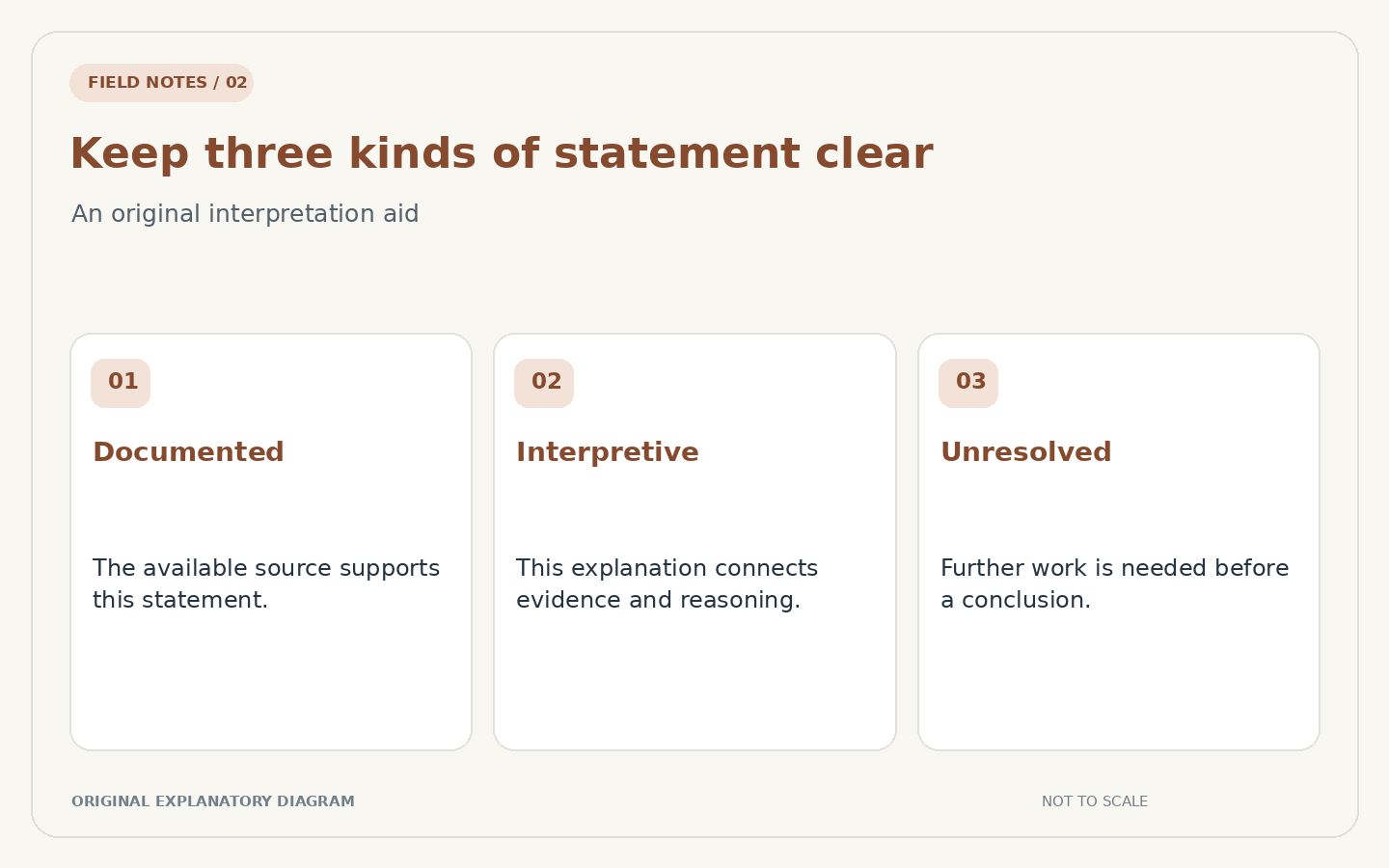
One rehearsal checks physical arrangements: entrances, crossings, gathering space, rest points, and a practical way to leave early. Another checks the narrative. Ask a reviewer to identify which statements are sourced, which are interpretations, and which are questions. A route can work physically while the explanation remains confusing, or the reverse.
Time the transitions as well as the speaking. If moving between stops consumes most of the session, reduce the number of stops. Leave room for participants to examine the source rather than merely hear a speaker describe it. A walk becomes a stronger learning experience when its pace allows people to notice, question, and connect what they have encountered.
Give participants a route back to the evidence
Finish with a concise source sheet and a clear distinction between settled statements and ongoing questions. Include the document titles and repositories used for the walk, along with the date the route information was checked. This allows a participant to continue learning without treating the guide's spoken account as the final authority.
Afterward, review questions that the group raised. Some may reveal an unclear explanation; others may identify a worthwhile research direction. Record corrections and use them in the next version of the walk. A careful campus history programme can acknowledge difficult evidence, preserve uncertainty, and remain open to further work while giving visitors a clear account of what supports each claim.
Sources
- History of the African American Burial Ground — Clemson University
- Teacher’s Guides and Primary Source Analysis Tool — Library of Congress